Monitoring can sound like a comfort blanket. It can be used to reassure people, without being very clear about what will actually be measured, how, by whom and what happens if the results are not what you hoped.
The Catchment to Coast version of monitoring is refreshingly unromantic. It’s mud, numbers and a lot of decisions about what not to claim, as well as what can definitively be learned.
Sediment, nutrients and bacterial load
Lucinda Robinson is doing her PhD on Catchment to Coast at the University of Essex. Nature-based interventions are not plug-and-play, so the monitoring can’t be either. Instead, Lucinda looks for “site-specific ecological changes”, tailored to what each intervention is trying to do.
In a salt marsh restoration, that means asking whether the physical conditions are shifting and whether life is coming back: “In the salt marsh we’re looking at the sediment. Is that changing? Are there plants establishing in the area? And how is that changing over time and through seasons?”
In wetlands, the questions are different: “When we look at the wetlands project, we’re looking at the water quality: is there decreased nutrient pollution, are there reduced bacteria loads?”
Monitoring Catchment to Coast is about finding the right ecological signal. It’s about evidence you can actually observe, connecting to the purpose of what is being built.
Repeatable by design
It is tempting to imagine that serious monitoring must involve high-tech kit. In the field, it is low-tech by design. “It looks like me wearing my waders and very much covered in mud” says Lucinda. “You don’t want to bring too much complicated machinery to a salt marsh because it’s going to get soggy and muddy.”
There are practical reasons for this, but there is also a principle. “We want these methods to be replicable for people in the future. We other councils or communities or groups or organisations to be able to redo these methods if they’re successful.”
The methods themselves are rigorously scientific and well-established: sediment coring, quadrat surveys, water-quality sampling, lab analysis. What’s deliberately kept light is the equipment people carry into the marsh.
Monitoring has to be good enough to trust scientifically and simple enough to replicate – for future councils making procurement decisions, for communities wanting to know what they should do and for funders and policymakers deciding what to fund. This is how learning travels.
Working with the landscape
Working in saltmarshes, at the edge of, and sometimes in, the sea, a flexible, inventive approach is needed. Lucinda talks about improvising when necessary. Corers, for example, are used to collect samples of soil and mud. “You’re building things as you go. I make my own corers that are lightweight and easy to transport.”
She makes “DIY corers, using syringes cut to size”, carries samples in a bucket, and, “if it’s super muddy, we use a snow sledge to carry and drag things along the marsh”. There are plant surveys with quadrats. This is painstaking, precision work but there are also occasional instances of getting stuck in the mud, and lost boots. This is what it means to collect data in a living landscape.
The clean bit: lab work
Back in the lab, the work becomes “a lot more high tech and a lot cleaner”. Samples are weighed. They are dried. Water content is measured. Lucinda uses a muffle furnace “to look at organic and inorganic carbon” and an analyser to look at “gases and things within the soil”.
And then there is the quiet slog that makes the results meaningful: “You get your data set and then you can analyse it from there.”
That sequence – field, lab, analysis – is the engine room of trustworthy claims.
Evidence with a purpose: BESE mats versus coir mats
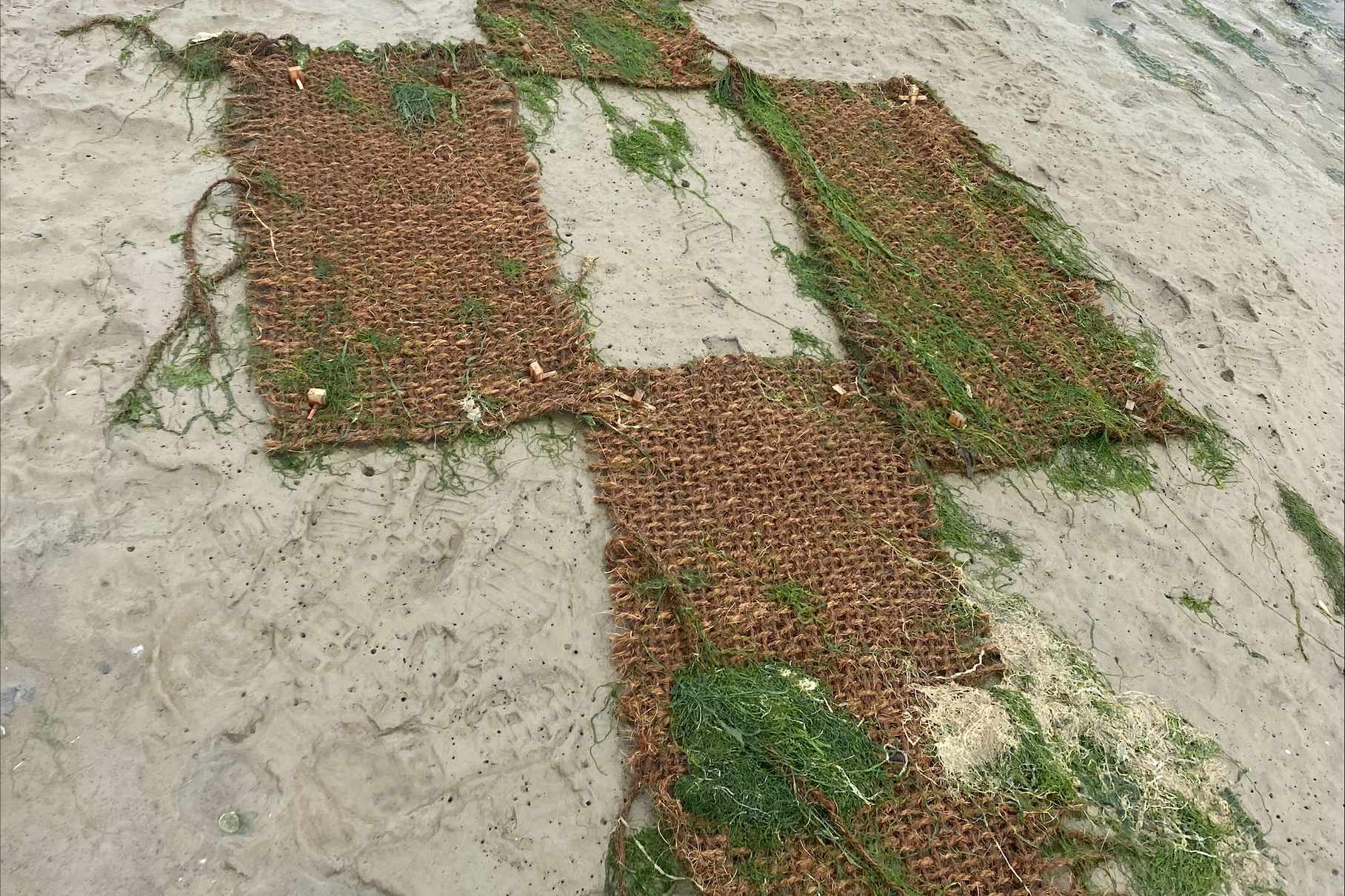
Monitoring matters most when it changes what you do next. Lucinda gives a concrete example from the salt marsh work. “We’re comparing BESE mats, which are potato starch mats, to coconut coir mats.”
Lucinda is assessing “the sediment and the plants”. At this stage, she is finding that “generally in the BESE mats, plants are able to establish earlier” and that “there are more complex plant communities”. But the monitoring does not stop at ecology. It includes the awkward practical questions that decide whether something is viable: “We’re looking not only at the effectiveness but also the practicalities. Are they getting washed away?”
So far, BESE mats are “currently performing slightly better” and have been “generally able to withstand more storms”. But “this is very early stages at the moment. So we’ll see what happens as the next summer comes along.”
That is what monitoring gives you: not always certainty, but clarity about what you know, what you do not know yet and what you are doing next to find out.
Monitoring as a public service
Lucinda’s work is obviously scientific, but it is also civic. It’s what turns innovation from a nice story into something that can be scrutinised, improved and eventually reused. “We want it to be able to be applied elsewhere and on scale.”
That’s the hidden ambition inside the muddy boots and cut-up syringes. Not just to say this worked, but to show how others could test it, in their own places, without necessarily needing a huge budget.
Monitoring Catchment to Coast is not a comfort blanket; it’s a disciplined way of being honest in public, and helping to build a better future.
Lucinda Robinson is a PhD student at the School of Life Sciences, University of Essex. Thanks to her and to the university for their help with this article.