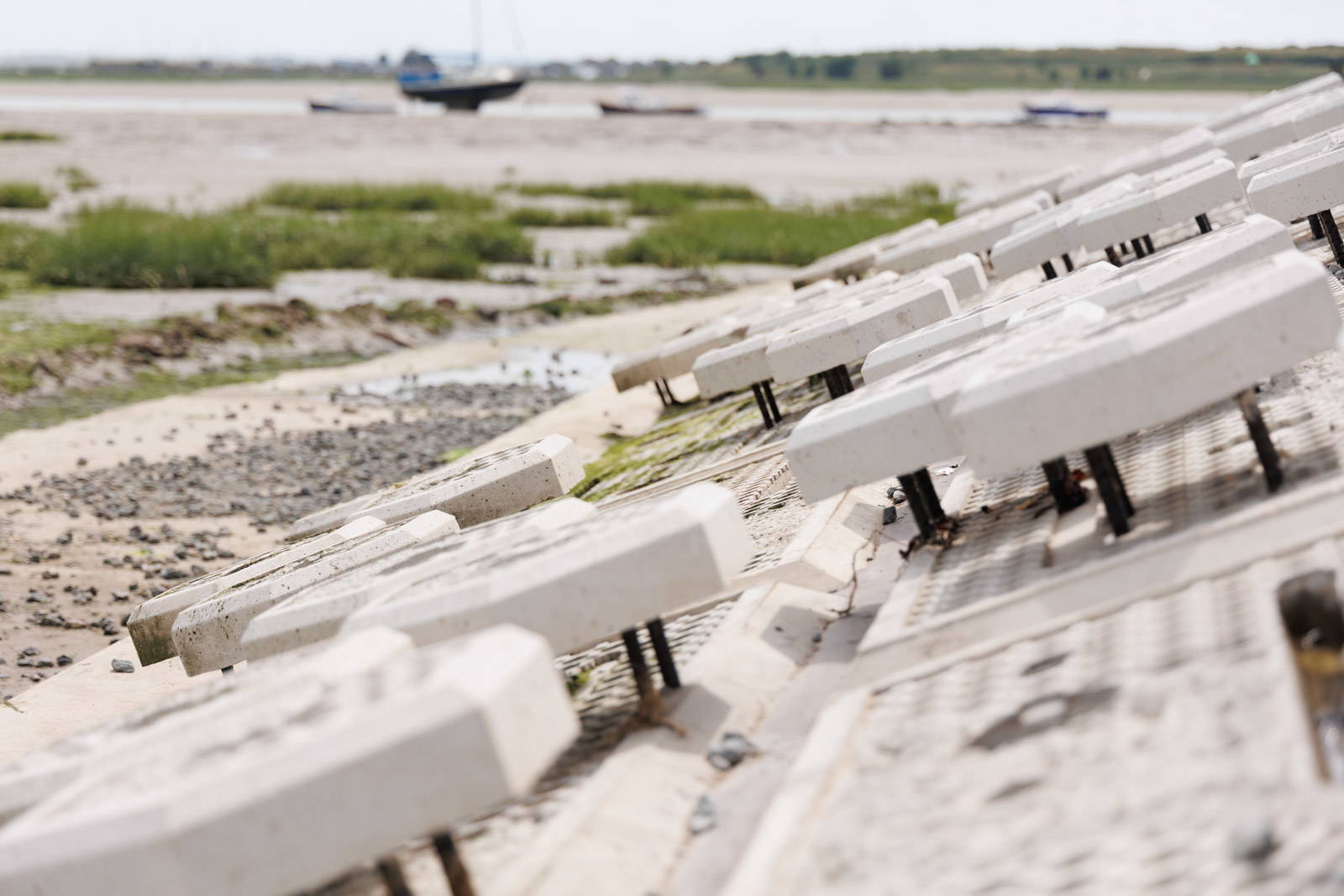
To improve the resilience of historic landfills from coastal erosion, a combination of innovative, nature-based solutions will be installed.
Exowalls and Exotiles have been deployed onto the existing seawall to help protect the aging asset. This is a bit like adding protective bubble wrap around fragile items! The measure we’ve used here uses bespoke Canewdon Blocks with wave-breaking exopanel technology, increasing habitats for native species.
These products are made out of recycled concrete and are textured to create small habitats for marine species.
Potato mats are an innovative starch biopolymer product made from potato waste. It’s a biodegradable lattice that helps reduce local currents and waves. It also provides shelter for wildlife. Coir matting will also be used in front of the seawall on the mudflat to encourage the saltmarsh to re-establish.
One of the most innovative ideas along the coast involved installing a floating barrier island to deflect and reduce the impact of waves on the shore. The barrier island would have had a large area of natural materials to reduce wave energy and also provide more habitats for wildlife. However, we have had to drop this plan due to problems with sending wave energy in different directions and potential environmental concerns.
Over the summer we are completing our precision GPS survey of the shoreline. The wave power and tide data we collect will be combined with info on the height and condition of defences. This will mean we can better map vulnerability.