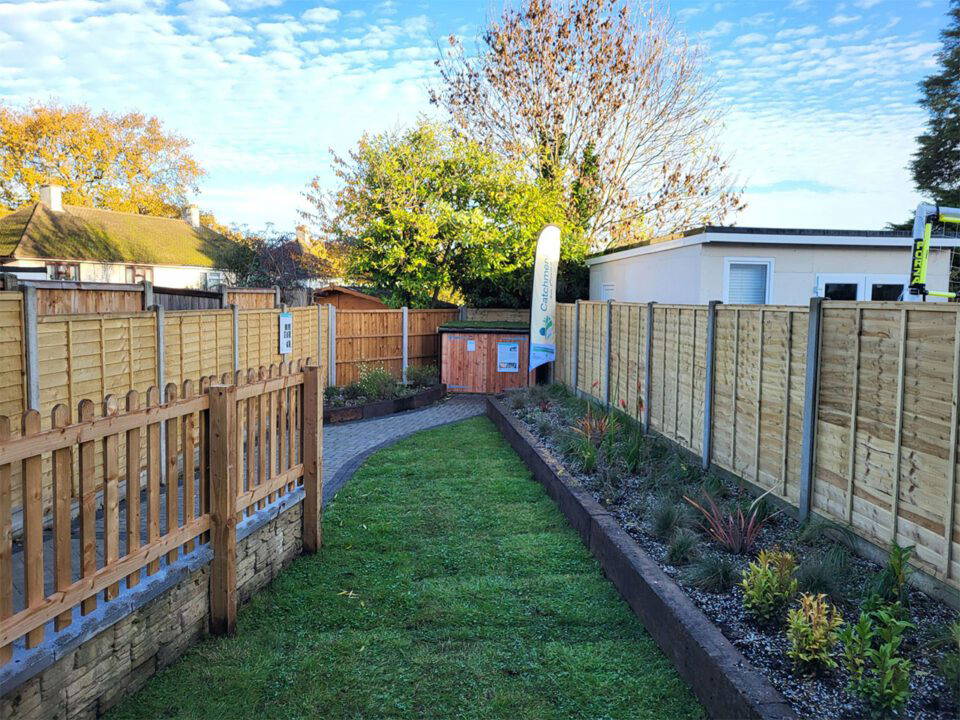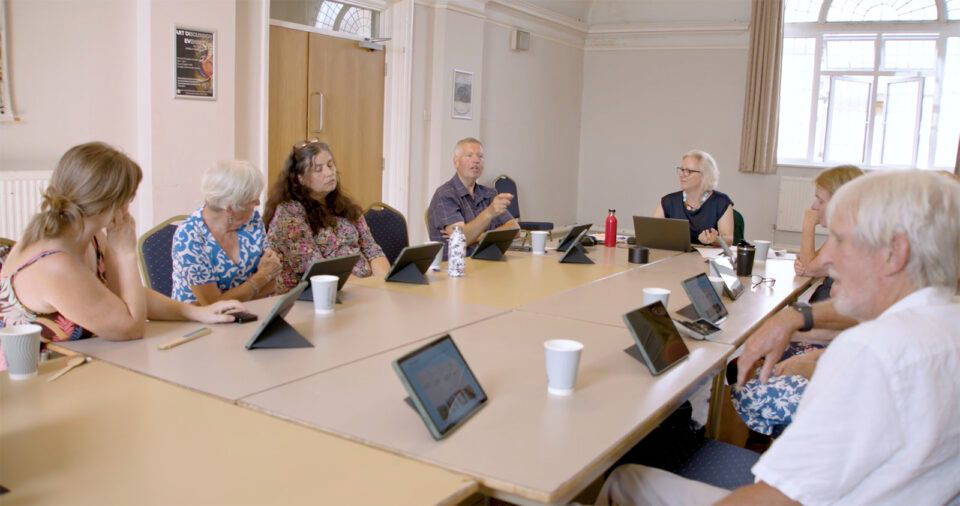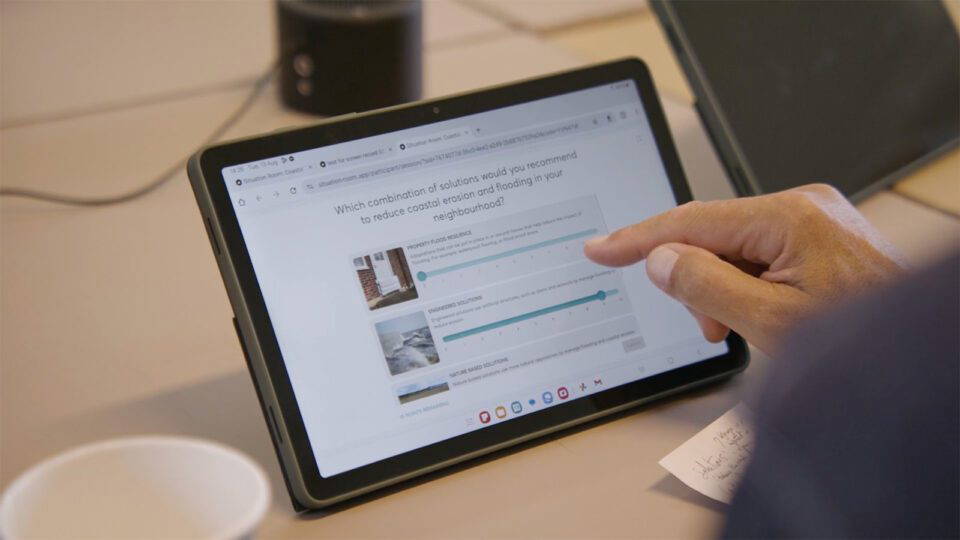
Few objects are as easy to overlook as a water butt. It sits in a corner of the garden, fills when it rains, and waters the tomatoes in July. But the idea behind it – catch the rain where it lands, instead of rushing it into an overloaded drain – turns out to be one of the more useful things we can do about water.
Our area has two opposite water problems. Too much, too fast, when heavy rain overwhelms drains and sewers and causes surface water flooding. And too little, when one of the driest corners of Britain tips into drought. Capturing rainwater helps with both at once. That’s the thinking behind the work starting now at Fairmead Avenue, in the middle of our catchment, where Catchment to Coast partner Our Rainwater is preparing to install 50 rain planters across the street.
We spoke to Abbi from Our Rainwater about what the devices do, why placing them well matters more than placing them everywhere, and how a water butt can end up feeling like part of the family.
A roundabout route to water
Abbi works in marketing and community engagement at Our Rainwater, which she joined nearly three years ago. Her route in was a roundabout one: she went to university later in life to study marketing and management, looking, she says, “to work with a purpose-led business by the end of my degree”. An internship in her final year turned into a permanent job.

What Abbi didn’t expect was how neatly it would close a loop. “Years ago, I was going to do geography when I left school,” she told us. “Some of the projects I did at school were on water scarcity. It’s weird that, 10 years later, I’m in an industry that’s combining all of my interests together.”
Having spent time in Devon and Cardiff – two of the rainier parts of the country – she is, at least, well acquainted with the raw material.
Managing water where it falls
Our Rainwater works with water companies, local authorities and communities to tackle surface water flooding and sewer spills. Rather than selling a single product, the company starts with the problem and works backwards to the fix.
“We’re agnostic to the solution. We’re purely trying to get the best solution in place for the challenge.”
That means the first step isn’t installation at all – it’s modelling. Our Rainwater’s technical team works out where devices will do the most good before anything goes in the ground.
“It’s about making the most impact, not just putting products in willy-nilly that we don’t know if they’re going to make any benefit. It’s choosing the best things that will make an impact.”
Faced with the scale of flooding and drought, it’s fair to ask whether a few barrels in a few gardens can really matter. The answer is that one device on its own is small – but devices are not placed at random, and they are not meant to work alone. Each is chosen for a location, and the benefits are designed to add up. It’s the same logic that runs through the whole of Catchment to Coast: lots of small, well-placed measures combining into a bigger effect.
Two problems, one idea
The case for catching rainwater rests on a simple observation. As Abbi puts it, climate change, population growth and more hard, paved surfaces from urbanisation are all making runoff worse – more water, arriving faster, with fewer places to soak away. That drives surface water flooding and, when sewers are overwhelmed, sewage spills into rivers and the sea. At the other extreme sits drought.
“Having the rainwater capture aspect, you’re tackling both sides at the same time. It’s a simple idea, but it is very effective.”
Hold water back when there’s too much, and store it for when there’s too little. The principle is almost old-fashioned in its plainness. The newer part is doing it deliberately, at street scale, and measuring whether it works.
Proving it works
Designing for impact is one thing; proving it is another – and Our Rainwater is candid that the evidence isn’t all in yet. Rain planters are a nature-based solution – they work with natural processes rather than against them – and that whole family of approaches has been studied far less than traditional “grey” engineering like pipes and concrete.
“There’s a lack of evidence in general for these types of solutions, just because they’ve not been trialled so much as your grey, big infrastructure projects. So a big part of what we’re doing is evidencing the effectiveness – looking at how much water is being held back, and other stats, so that we can see the real-world performance.”
So the devices are monitored once installed, on projects going back several years, with the intention of gathering real numbers, not just hopes. There’s a plan to let householders see their own statistics too, with a gamified twist. Building the evidence base is part of the point, not an afterthought.
More than a water butt
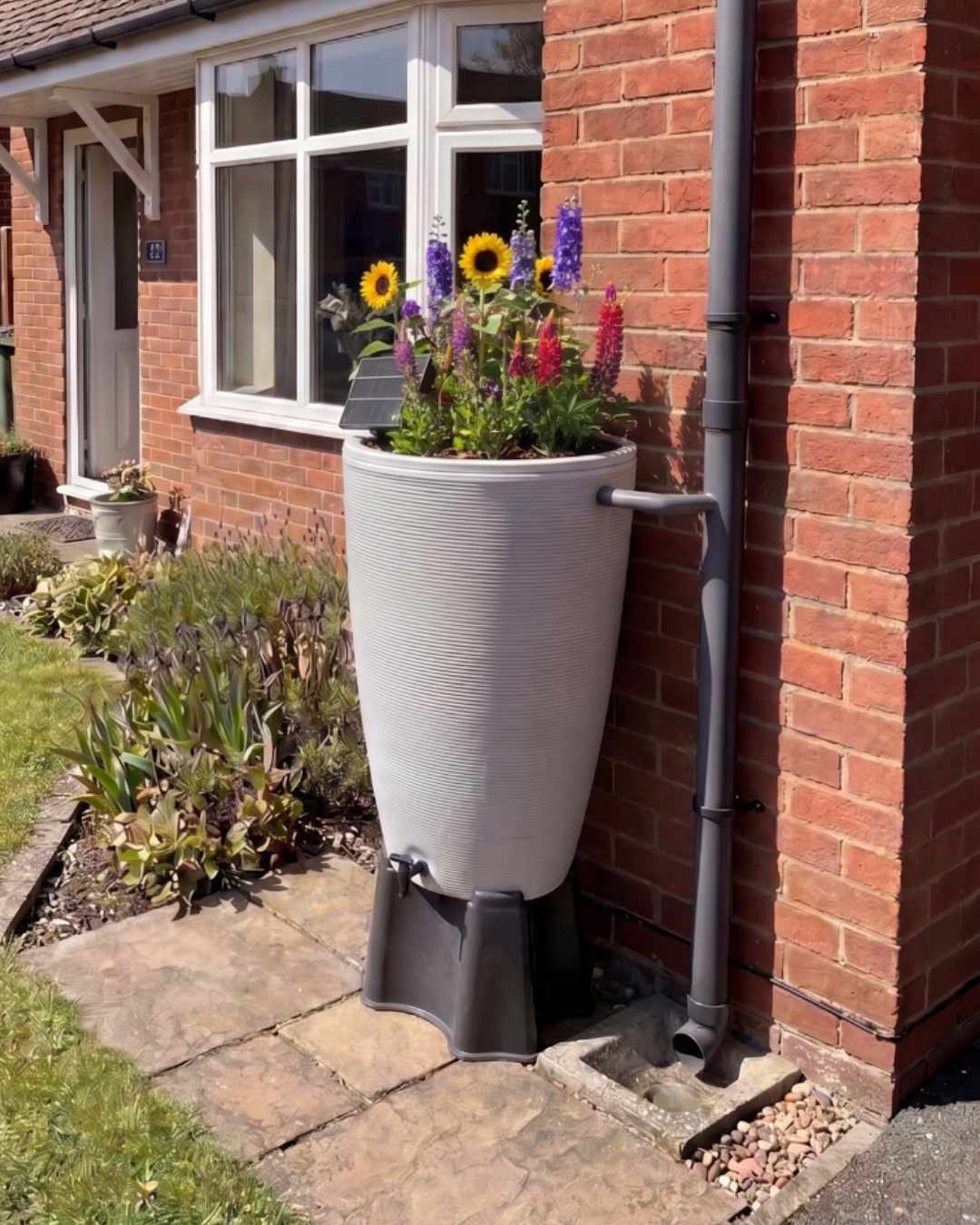
The devices themselves are a step on from the classic green butt. Our Rainwater developed three types specifically for Catchment to Coast. Two are planters with a bowl of soil on top for herbs, flowers or a few small crops – so they earn their place in the garden as well as in the drainage plan – and the third is a smart, internet-connected tank. (Attenuation, a word that comes up a lot here, simply means holding water back and releasing it slowly, rather than letting it rush away all at once.)
- Smart Tank (120 litres): connected to the internet, it checks the forecast and empties itself ahead of a storm, so there’s always room for the next downpour. The stored water is available for any non-potable use – the garden, outdoor cleaning.
- Square Planter (128 litres): focused purely on holding water back during heavy rain, with the planting space on top.
- Pillar Planter (255 litres): the in-between option, with around 50 litres kept back for reuse in the garden and the rest given over to attenuation.
Where there’s room, a household could have more than one – say, one storing and one for reuse.
Why ownership matters
The part Abbi returns to most often isn’t the hardware, it’s the people. A device bolted to a downpipe and forgotten does little good; one that a resident feels is theirs gets looked after, talked about and kept running for years.
“You don’t want it to just be ‘here’s a water butt, goodbye’. They need to feel involved. A bit like the IKEA effect.”
The IKEA effect – valuing something more because you had a hand in making it – is a neat way to describe what Our Rainwater is after. Much of the work is in-person: building rapport, and recruiting “rainwater champions” who spread the word, share local knowledge and bring others on board. The aim is for people to see a rain planter as part of their home, not a piece of council kit parked outside it.
The connection can run surprisingly deep. One person we spoke to recently, confessed they were anxious their water butt hadn’t filled before summer. That small worry is exactly the point: when people feel a stake in the water around them, the project stops being someone else’s and starts being everyone’s. As Abbi notes, this is a long-term issue, “so it needs to be sustainable – rather than one and done”.
Teaching water, with gutters and mud
That same instinct runs into Our Rainwater’s work with schools, where their education consultant, Nick Couzens, runs hands-on workshops – “a whole physical set-up of gutters, mud, all outside” – to get children thinking about how water moves through their environment. More widely, the company uses its channels to raise awareness of water challenges in general, on the grounds that everything here is connected. The more people understand the system, the more likely they are to join the dots themselves.
The benefits that get overlooked
Flood and spill reduction is the headline, but it isn’t the whole story. Abbi was keen to point out the quieter gains:
- Carbon savings: rainwater kept out of the network, and used instead of mains water, means less treatment and pumping. “It’s something that gets overlooked, and it’s actually really important,” she said. “On a big scale, it’s going to add up if lots of people are doing it.”
- Biodiversity: the planting space is small, but more greenery is more greenery – good for bees, butterflies and other visitors looking for a habitat.
- Drought resilience: stored water means a garden can keep going through a hosepipe ban, which matters in a corner of the country as dry as ours.
- Cleaner water: slowing the flow, and letting some of it pass through soil, helps reduce the pollution that would otherwise wash straight into our waterways.
Why this fits Catchment to Coast
Fairmead Avenue sits in the middle catchment, and the choice of street came out of Catchment to Coast’s own modelling and monitoring. We picked somewhere the difference the devices make can be measured. For Abbi, that experimental breadth is what makes the wider project stand out.
“It’s almost a one-of-a-kind project. Catchment to Coast is trying so many different methods and taking that broad approach across the whole catchment. With the UK being battered by wind, rain and God knows what, it’s going to be really important going forward to take those learnings and implement them in other projects.”
That’s the ambition in a sentence: try many things in one place, measure honestly, and pass on the best of it – through blueprints and shared learning – so others don’t have to start from scratch.
What’s happening at Fairmead Avenue
The Fairmead Avenue work began last year, then had to be paused; now it’s picking back up. A group of residents already signed up are being re-contacted to check they’re still keen, and the rest of the street is being invited to take part. Our Rainwater colleagues have been out door-knocking, handing out flyers and chatting to neighbours. The team is aiming to have the planters installed by July.
How to get involved
If you’d like a rain planter, or simply want to register your interest, it’s a short process:
- Sign up via the Catchment to Coast campaign page with your name, email and postcode, and you’ll find out whether your property is in an eligible project area.
- If it is, you’ll be asked to upload a few photos of your downpipes so the team can check the materials and the space available.
- Once that’s approved, you’ll get a booking link to arrange a professional installation during the install weeks.
And if you’re not in a current project area? Signing up still helps. The more interest a neighbourhood shows, the easier it is to get a future project off the ground there – so registering, sharing on social media and telling friends and family all make a difference. Even a repurposed barrel of your own does its bit. Anything that slows the flow, and gets more of us thinking about where our water goes, is a small win for the whole catchment.